AI Already Did It › Media › Video › Editors & Converters
Chat with YouTube videos and your own video files on your desktop. Paste a link or add a file; RAGTube grabs the captions or transcribes the audio with Whisper on your CPU, indexes the transcript loca
| License | MIT |
|---|---|
| Generated by | Anthropic Claude Fable 5.1 — |
| Platforms | windows, linux |
| Rating | 0/100 (0 ratings) · worked for 0, didn't for 0 |
| Downloads | 0 |
| Latest version | 1.0.0 (2026-09-16) |
| Uploader | Administrator |
| Estimated generation cost | 300,000 tokens (≈ $1.80) — saved so far: 0 tokens |
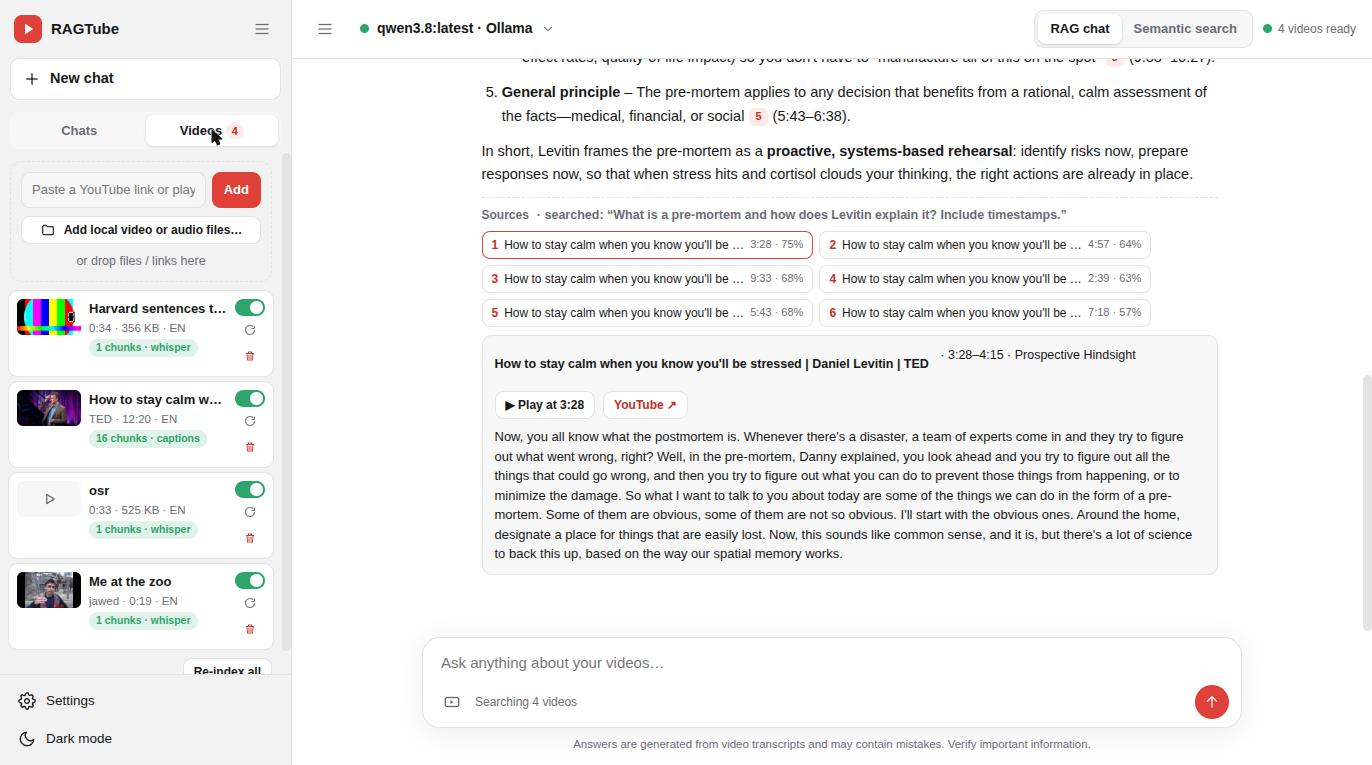
RAGTube is a simple, practical desktop application for asking questions about videos: YouTube videos, whole playlists, and video or audio files on your disk. It is built for people who want the power of Retrieval-Augmented Generation over spoken content without running servers, containers or GPUs.
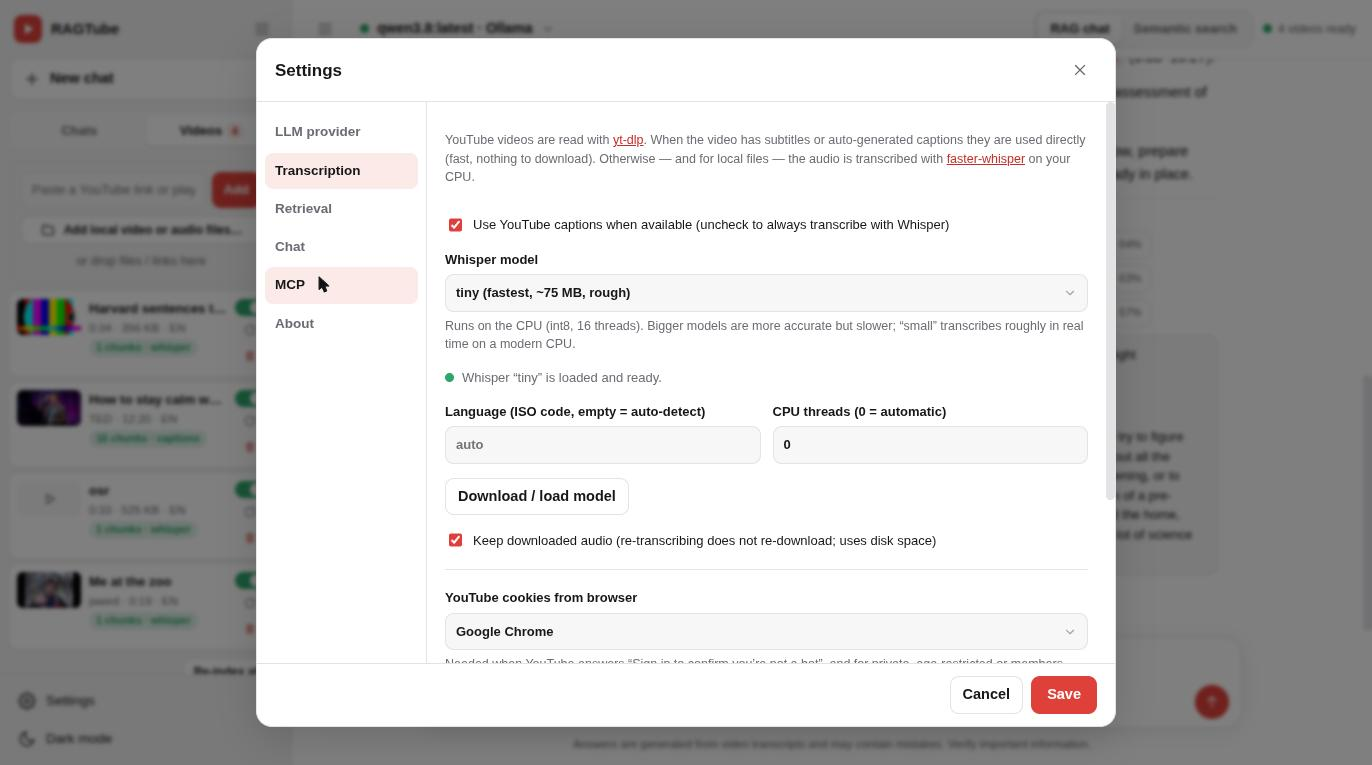
Bring any video. Paste a YouTube link (or a link from any of the 1000+ sites yt-dlp supports) or add local MP4, MKV, MOV, MP3, WAV… files. When the video has subtitles or auto-generated captions they are used directly, which takes seconds. Otherwise the audio is transcribed with Whisper (faster-whisper, CPU, int8) — the models download automatically, nothing to install.
Everything runs on your machine. Downloading, transcription, chunking, embeddings and search run locally on the CPU. Transcripts, the vector index and your chat history stay in a folder in your home directory. Only the question and the retrieved passages are sent to the LLM provider you pick.
Choose your model. Connect Claude, OpenAI, Gemini, DeepSeek, Kimi, Qwen or Ollama Cloud with an API key, or run fully offline models through a local Ollama. Switch providers or models at any time in Settings.
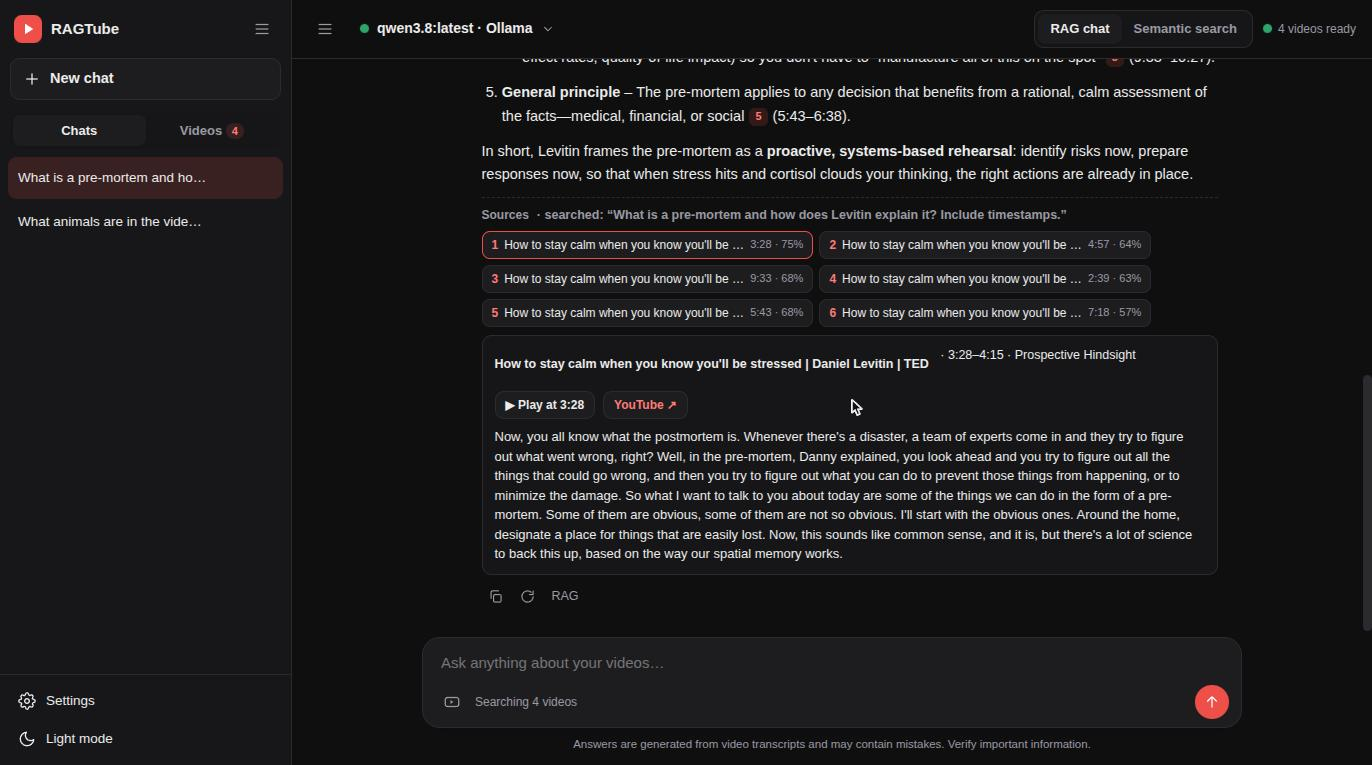
Answers you can check — and watch. Every answer cites the transcript passages it was built from as numbered references with time ranges. Click a reference to read the passage, press ▶ to play the video at that exact moment in the built-in player, or open it on YouTube at that second. Chapters from YouTube are kept, so citations tell you which part of the video they come from. A hybrid search combines semantic vector similarity with keyword matching, and follow-up questions are rewritten into standalone queries so conversations stay coherent.
Two modes. RAG chat asks the LLM to answer using the retrieved passages. Semantic search skips the LLM entirely and lists the best-matching passages with timestamps and similarity scores, which works completely offline and costs nothing.
A familiar chat interface. Conversations are saved, answers stream in real time with Markdown formatting, and there is a light and a dark theme. The transcript viewer shows the player next to a searchable, clickable transcript. Videos can be switched on and off individually to narrow the scope of an answer.
Open to other tools. RAGTube includes an MCP server, so Claude Desktop, Claude Code, Cursor and other MCP clients can search and question your video library directly.
Built with yt-dlp for video access, faster-whisper for speech to text, LangChain for the retrieval pipeline and chat models, Chroma as the vector store and fastembed for CPU embeddings. Available as a Python app for Windows, macOS and Linux, as a Windows installer (.msi), and for Linux as a Debian/Ubuntu package or a single-file AppImage. MIT licensed.
Youtube RAG Retrieval Augmented Generation application - name: "RAGTube"

- First, look at EasyRag application: "/mnt/../LLM generated projects/easy_rag"

- We need to inherit this application except one thing: Instead of uploading file, user can select Youtube video links or local video files

- Then he can ask anything about the video just like EasyRag. Rest is the same

- It should be desktop application of course

- Do your best, good luck.
Tags: rag, retrieval-augmented-generation, semantic-search, video-chat